


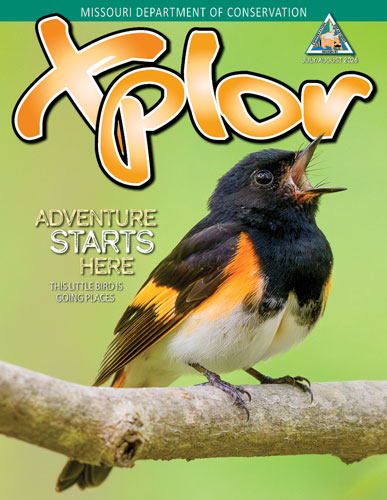

Imagine going on a trip. You have neither a suitcase, a phone, nor a map. To reach your destination, you must fly over a thousand miles and pit your wits against hungry predators and violent storms. And, oh yeah, you weigh less than two U.S. nickels.
Wow, what a summer!
It seems like only yesterday it was spring, and you had just arrived in northeast Missouri at this charming patch of woods on the banks of the Mississippi. You’re an American redstart, a colorful, insect-munching, sweet-singing songbird.
Over a few weeks — it’s all a blur, now — you met a mate, settled down, raised a nest of youngsters, sent them out into the wide, wild world, lost a few well-worn feathers, and grew a few new, sturdier ones. Now, after all of that, you feel restless, like there’s something else you need to do.
Heat waves make trees on the horizon shimmer as if they were underwater. It’s August — the hottest month of summer — but you sense the days are growing shorter and winter will soon be here. Time flies, and now, you should too. The only question is where?
Fly north. You’ve heard Canada is lovely. Go to 1.
Fly south. The beach sounds better. Go to 2.
1 - You were right, Canada is delightful. You loved how the sugar maples blazed in autumn like their leaves were on fire. And how snowflakes seesaw out of the sky and pile up on spruce boughs like puffy, little pillows.
Wait a second. Snow?!
Cold you can handle. You wear a coat of cozy feathers after all. But you know who doesn’t do well in the cold? Insects. And you know what you stuff in your beak hundreds of times a day? Insects.
A rumble in your tummy reminds you it’s been a bit since your last meal. You realize you made a terrible mistake.
Maybe it’s not too late to fly south. Go to 8.
2 - Some birds, like barn swallows and hawks, migrate during the day. But you, like most songbirds, migrate at night when the wind is calmer, the air is cooler, and darkness hides you from predators.
Somehow, you know which way to go. Itty-bitty bits of metal in your beak feel the pull of Earth’s magnetic field. The movement of stars across the night sky also offers clues about which direction you’re heading.
That is, when you can see them.
Ahead, the lights of a city blaze brightly, extinguishing your star map. Before you can change course, you’ve sailed directly into downtown St. Louis.
Suddenly, the wide-open sky becomes a canyonlike maze of strip malls, ballparks, and skyscrapers. Headlights of cars streak through the streets below. It’s very confusing! Panic flutters in your stomach like a June bug popping against a porch light. You’d better do something before you get hopelessly lost …
Those lights up ahead might, uh, shed some light on your problem. Go to 3.
A large, light-free section of the city looms off your left wing. Darkness seems safer, right? Go to 4.
3 - What happened?! You remember flying toward the light and then … CRASH! The next thing you know, you’re lying on the sidewalk at the base of a towering skyscraper. As you shake your head groggily, you realize you must have crashed into a window.
Luckily, you don’t seem to be hurt, just stunned. Sadly, you can’t say the same for the wood thrush that lies crumpled and still nearby.
Out of the corner of your eye, you spot a cat creeping out of an alley. You decide not to stick around to see what it wants, so you burst back into the safety of the sky.
Go to 4.
4 - Whew! You made it out of the maze of the city and found a comfortable oak tree to perch in. You seem to be in a city park. The sun is peeking over the eastern horizon, so you decide to stop here to rest. As your eyelids begin to droop, you hear a flock of blue jays shrieking at something. They sound upset! Maybe you should fly over and see what’s up?
Hard pass. You’re … really … tired. Zzzzzz. Go to 8.
On the other wing, it might be fun to see what trouble those loud-beaked birds are getting into. Go to 5.
5 - The jays, nearly a dozen of them, are fluttering around a hickory tree. Every so often, one of them drops into the foliage and then quickly swoops back out. They seem to be dive-bombing something. You fly to a nearby tree for a closer look …
Oh, bird droppings! It’s a sharp-shinned hawk!
Sharpies are the cheetahs of the bird world. They use speed and agility — along with bone-crunching talons and a meat-shredding beak — to snatch songbirds about the size of, well, you. While you watch, frozen in fear, the hawk turns its head and pierces you in the gaze of its blood-red eyes.
Quick, duck behind a leaf! Maybe the hawk didn’t see you. Go to 6.
Fly away! With a head start, maybe you can outrun it. Go to 7.
6 - As you hide behind the leaf, your heart begins to pound so hard you worry the hawk might hear it. You notice the jays have become eerily quiet. You peek around just in time to see the sharpie launch off its branch and hurtle, like a feathered missile, toward the tree you’re hiding in.
No choice now. You’ve got to get out of here! Go to 7.
7 - You fly away as fast as your little wings will carry you, zigzagging around trees. The hawk crashes through the foliage in hot pursuit, using its long tail to steer around branches. You feel the whump of its wings and hear the clack of its beak. Closer and closer it gets. You can’t shake it. Just when the sharpie is reaching out its claws to put an early end to your trip, a blue jay dives out of the sky and pecks the hawk on the head. Surprised and enraged, the hawk forgets about you and wheels toward the shrieking flock of jays.
You don’t stick around to see what happens next. Go to 8.
8 - The days drift by, and you fall into a routine. At night, you fly as far as you can. In the morning, you find a patch of woods, eat a few bugs, and rest your weary wings during the heat of the day. When night falls, you set off again.
The calls of other migrating birds ring out in the darkness, urging each other on, warning of hidden dangers ahead. Night by night, the feathered parade makes its way south. Usually you cover about 40 miles a night, but with the wind at your tail, you can make nearly 100.
Eventually, you reach the Gulf Coast. Angry waves crash onto the shore, throwing seaweed onto the sandy beach. Though the sky looks clear, you hear an eerie, low-pitched rumble far out over the ocean.
It sounds like a storm. Maybe it’s best to get out of its way. Go to 9.
You’ve flown so far! There’s no way you’re turning around now. Go to 10.
9 - It’s a good thing you flew inland! Two days after you left the coast, Hurricane Gabriel churned through Alabama, ripping off roofs and tearing out trees. By the time it reaches you, hunkered down in a patch of pine woods, the Category 4 hurricane has weakened into an only-slightly-scary band of thunderstorms.
Once the lightning, wind, and rain has passed, you return to the coast. Go to 12.
10 - You took a terrible risk, and it could be your last.
You set off at dusk across the angry ocean and flew headfirst into Hurricane Gabriel. Winds toss you up, down, and sideways like a plastic grocery sack. Somehow you manage to fight through the torrential rain and reach the calm eye of the storm. The only problem is now you’re surrounded by a hurricane. To survive — your only chance, really — is to stay inside the eye and go wherever it takes you.
You filled your belly with bugs before you left land. You hope it’s enough. If you run out of fuel …
Well, it’s best not to think about that. Go to 11.
11 - The hurricane spits you out on the coast of Alabama, a few miles east of where you left the night before. You lie on the beach, too tired to move.
You feel lucky to be alive. Go to 12.
12 - Nom, nom, nom. So much to eat, so little time.
Crossing the ocean is the riskiest part of your journey. To make it, you need extra fuel in your tank. So, for the next few days, you creep through the canopy, hunting insects.
Like all redstarts, you have a trick to catch your prey. As you hop from branch to branch, you droop your wings and flick open your tail, revealing bright patches of color. Male redstarts have Halloween-orange spots; females and youngsters have lemon-yellow spots. The sudden flash of color startles Leafhoppers and other insects, which flush from their hiding places, only to be snapped up by your hungry beak.
You’re hard at work bagging bugs when a supersized snack flutters by. It’s an orange-and-black butterfly, and it’s nearly as big as you. It would be quite a feast …
What are you waiting for? Grab it before it gets away! Go to 13.
Something feels wrong. You’ll stick to leafhoppers. Go to 14.
13 - As soon as you swallow the butterfly, you know you’ve made a mistake. Your stomach gurgles and churns. You feel like you’re going to be sick. Ugh. No. Oh, no! Barf!
Once you’re done throwing up, you swear you’ll never eat another butterfly. Those orange-and-black colors must have been a warning. They taste awful!
Lesson learned. Go to 14.
14 - With the wind at your back and a bowl of stars twinkling overhead, you point your beak south and take flight. Over 600 miles of shark-filled seas lie between you and the next speck of land — and you can’t swim.
The lights of fishing boats and cruise ships ripple across the ink-black water. You zip past them unseen, high overhead, flapping your wings for all you’re worth.
At sunrise, you make landfall on the west coast of Cuba. The mangroves here squirm with bugs.
You top off your tank and drift into a deep, well-earned sleep. Go to 15.
15 - You hopscotch down the spine of the island until you reach a beach on the southeast coast. There, you strike out over the open ocean once more. After making it across the empty, enormous Gulf, this feels like hopping over a puddle.
In no time, you’re sailing over the palm-lined beaches of Jamaica. Though they look tempting, you push past them. Up, up, up you go, into the lush jungles of the Blue Mountains, where, at long last, you come to rest in the shade of a coffee plantation. Home sweet home!
And here, your adventure comes to an end — at least until you return north next spring.


Also In This Issue

Join us for a tour of Missouri’s littlest lizards.
And More...
This Issue's Staff
Photographer – Noppadol Paothong
Photographer – David Stonner
Designer – Marci Porter
Art Director – Ben Nickelson
Editor – Matt Seek
Subscriptions – Marcia Hale
Magazine Manager – Stephanie Thurber