


Missouri Conservation Commission Gives Initial Approval of Regulation Changes, New Permits
MDC asks for public comments before proposed regulation changes and permits are finalized in September
Fall Nonresident Deer Hunting Regulations Modified
The Missouri Conservation Commission approved proposed changes to nonresident deer hunting regulations at its May 29 open meeting in Washington.
The approved regulation change for the upcoming 2026 deer season reduces the nonresident antlered buck bag limit from two to one. Nonresident landowners who qualify for nonresident landowner permits will maintain an antlered buck bag limit of two.
The commission also gave initial approval to a regulation change that would require nonresident deer hunters to purchase a Nonresident Public Land Deer Hunting Permit for $165 to be able to pursue, take, possess, and transport deer on public land in Missouri, including conservation areas and other state and federal public lands, beginning with the 2027 deer season.
If given final approval, this permit will become effective for the 2027 deer season.
Proposed Camping Permit
For many Missourians, including hunters, anglers, floaters, and other outdoor enthusiasts, camping is a popular activity. MDC manages about 1,000 conservation areas around the state, with more than 320 offering free camping.
Campers and MDC staff have noted an increasing number of problems on conservation areas involving compliance issues, safety concerns, and environmental impacts from vandalism, illegal activities, and illegal stays on camping sites.
Currently, campers on MDC areas do not need a permit, do not pay a fee, and do not register to camp. This lack of information can cause problems for conservation agents and MDC staff when they need to regulate activities on a camping area or identify campers causing problems or engaging in illegal activities.
To help better regulate and monitor activities on our camping areas, MDC is proposing a low-cost, five-day permit for all camping on conservation areas for up to 10 people. The “$5-for-5-for-10” permit would cost $5 for up to 5 days (and four nights) of camping for a group of 10 people or fewer, even if fewer days were used and fewer people participated.
If given final approval, the changes will become effective Feb. 28, 2027.
Proposed Permit for Unstaffed Firearms Shooting Ranges
MDC offers free recreational firearms shooting on more than 35 unstaffed shooting ranges around the state. The ranges were designed decades ago primarily for hunters, who traditionally used them during the spring and fall in preparation for various hunting seasons.
Range use has increased significantly in recent years with more home/self-defense firearms practice and increasing use of modern sporting rifles. Increased use has also resulted in more damage to shooting range signs, booths, and other infrastructure from some visitors, along with increasing litter from some shooters, including spent shells, targets, and other items.
To help reduce range damage, litter, and misuse, MDC proposes requiring users of our unstaffed firearms shooting ranges to have a valid small game permit. Existing age and disability exemptions will remain. The proposed regulation changes would apply only to MDC-owned unstaffed firearms shooting ranges, not partner ranges or MDC’s five staffed shooting ranges. For residents, the allowable permit options start at $11.50 for an annual small game permit. For nonresidents, daily small game permits are $16 and annual small game permits are $108.50.
If given final approval, the changes will become effective Feb. 28, 2027.
Get more information and comment on the proposed regulation changes from July 16 through Aug. 14 at short.mdc.mo.gov/oTj. After reviewing the public’s comments, the commission will give final consideration to the proposed regulation changes at its open meeting on Sept. 11.
Apply Online for Managed Deer Hunts
Beginning July 1, deer hunters can apply online through the MDC website for a chance at more than 100 managed deer hunts throughout the state this fall and winter. The managed deer hunt application period is July 1–31. Hunters are selected by a weighted random drawing. Draw results will be available Aug. 15 through Jan. 15. Applicants who are drawn will receive area maps and other hunting information by email or mail if an email address is not located on the customer’s account.
MDC offers managed deer hunts for archery, muzzleloading, crossbows, and modern firearms from mid-September through mid-January at conservation areas, state and other parks, national wildlife refuges, and other public areas. Some managed deer hunts are held specifically for youth or for people with disabilities.
Get more information on managed deer hunts, preview hunt details, and apply at mdc.mo.gov/managedhunt. Details about managed hunts also can be found in the 2026 Fall Deer & Turkey Hunting Regulations and Information booklet, available starting in early July at MDC offices and nature centers, permit vendors around the state, and online at mdc.mo.gov/hunting-trapping/regulations.
Celebrate Safely
As you celebrate this summer, MDC reminds you to be careful with fireworks, campfires, and other sources of fire that could cause a wildfire.
Fireworks: Don’t light fireworks in areas where sparks could ignite dry grass, leaves, or other potential fire fuel. Always have an approved fire extinguisher and an available water supply to douse sparks or flames. Wet the area around where fireworks are being discharged. Check with local ordinances and authorities for bans on fireworks and open burning.
Outdoor Burning: Don’t burn during unfavorable conditions. Dry grass, high temperatures, low humidity, and wind make fire nearly impossible to control. Check with local fire departments regarding burn bans that may be in place. A person who starts a fire for any reason is responsible for any damage it may cause.
Driving Off Road: Wildfires can start when dry fuel like grass meets catalytic converters. Think twice before driving into and across a grassy field. Never park over tall, dry grass or piles of leaves that can touch the underside of a vehicle. When driving vehicles off road, regularly inspect the undercarriage to ensure that fuel and brake lines are intact and no oil leaks are apparent. Always carry an approved fire extinguisher on vehicles that are used off road. Check for the presence of spark arresters on ATV exhausts.
Making a Campfire: Clear a generous zone around fire rings. Store unused firewood a good distance from a campfire. Never use gasoline, kerosene, or other flammable liquids to start a fire. Keep campfires small and controllable. Keep fire-extinguishing materials, such as a rake, shovel, and bucket of water, close. Extinguish campfires each night and before leaving camp, even if it’s just for a few moments.
Call for Help: Call 911 at the first sign of a fire getting out of control.
Report Forest Arson: Wildfires are sometimes set by vandals. Help stop arson by calling 800-392-1111 and reporting any potential arson activities. Callers will remain anonymous and rewards are possible.
Prescribed Fire: Fire used in the wrong way can create disasters. Used in the right way, fire can help create habitat for wildlife. For more information on using prescribed fire as a land management tool, visit short.mdc.mo.gov/Zrf.
Frog Gigging
By Jenna Stiek
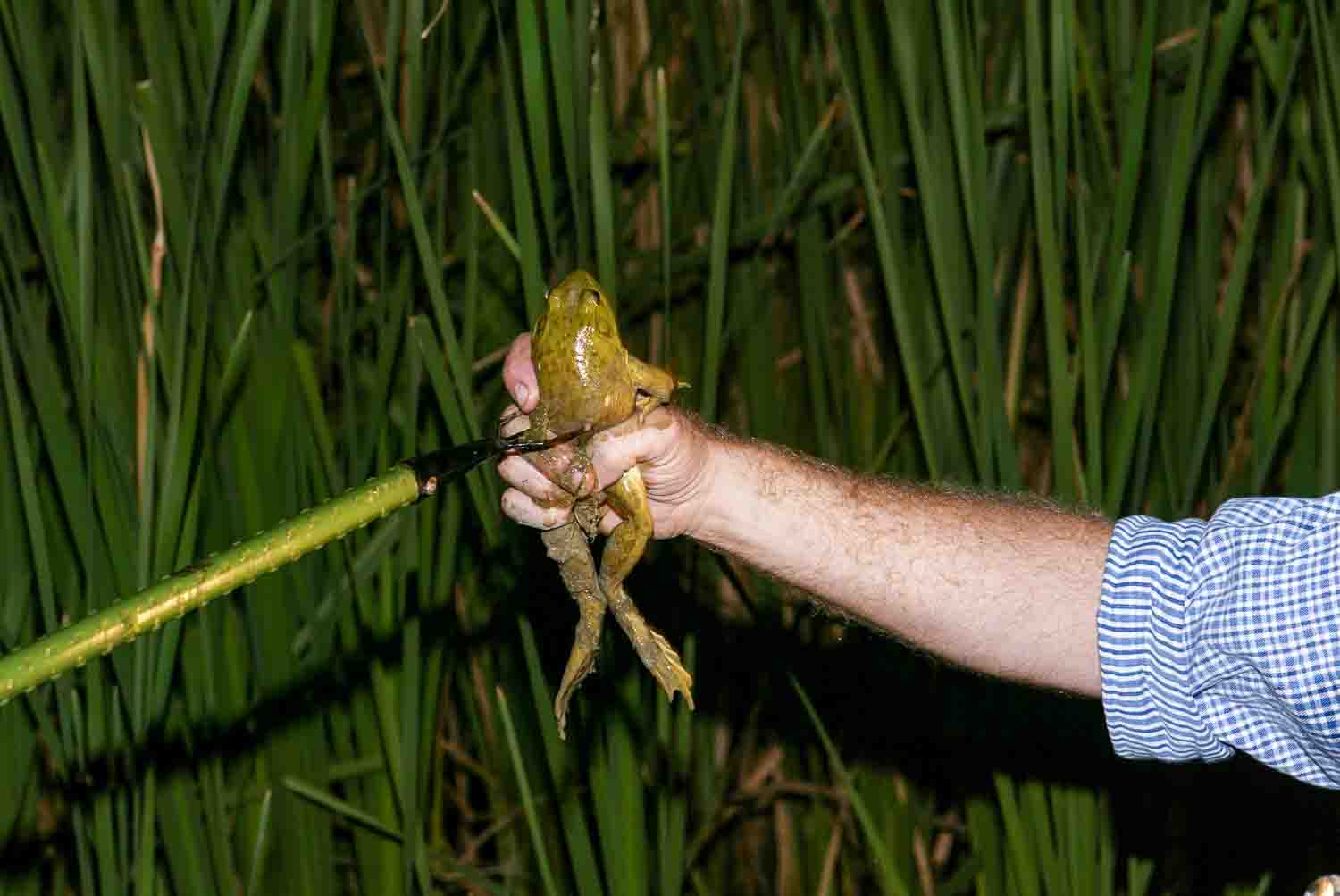
Frog gigging is a popular summer activity that begins at sunset on June 30 and runs through Oct. 31. Frog gigging takes place at night, so it requires a combination of stealth, artificial light, and careful listening.
The frog’s eyes are illuminated by the light, allowing them to be seen along the bank. The bright beam temporarily dazes the frog, allowing for a close approach and a successful strike. Frogs can also be located by listening for their croak. It is a deep, loud call from males to establish territory and attract females.
A Missouri fishing permit or Small Game Hunting Permit is required for residents aged 16 to 64. The daily limit is eight bullfrogs or green frogs, with a possession limit of 16.
Methods:
With a fishing permit, frogs can be taken by gig, which is a metal spear with three to four prongs, attached to a 5–8-foot pole. But they can also be taken by trotline, throw line, limbline, bank line, and jug line; snagging; snaring; grabbing; or pole and line.
With a hunting permit, frogs can be taken by crossbow, pellet gun, .22 or smaller caliber rim fire rifle, or pistol.
With either permit, frogs may be taken by hand, net, bow, or atlatl.
Equipment: You will need a frog gig, rubber knee boots or hip waders, bug spray, flashlights, headlights, a net, and a breathable mesh bag to keep the harvested frogs alive while hunting. Wire fishing baskets and a 5-gallon bucket with a lid to prevent escape are recommended. It is important to keep the frogs damp, so the meat stays cool and fresh.
Location: Ponds, lakes, wetlands, riverbanks, and other waterways with vegetation are all great places to find frogs. Water with few to no predators will yield the best frog populations, which is why newer ponds or very old ponds are usually prime locations.
After the Harvest: You will need a pair of shears and a filet knife or pliers to process the frog. Lay the frog on its belly and use the shears to cut the body in half just above the hip joints. Insert a finger underneath the skin on the frog’s back and push to the base of the legs. Then pull the skin towards the legs and remove the feet at the ankle joints. Rinse the frog legs under cold water. To remove slime and the gamey flavor, soak the legs in salt water for 1–2 hours or overnight. Pat dry before cooking. The most popular way to prepare frog legs is by deep frying them, but they can also be prepared by baking or smoking.
In honor of our nation’s 250th birthday, we offer a spin on this month’s What IS it? Can you guess the red, white, and blue natural wonders?
Blue clues:
- When I get cut, I “bleed” blue “milk.”
- One of Santa’s reindeer shares my name.
- I shine blue in the sun and turn black in the shade.
Red and White clues:
- One of Missouri’s most successful sports teams is named after me.
- Look at me! I’m Missouri’s official state tree.
- I grow where it’s damp, but I’m as dry as a piece of chalk.
- My beak’s bigger than any other in Missouri.
- Although I’m one of Missouri’s most colorful reptiles, I’m really hard to see.
- I’m an angel — but not a good kind.
- I bloom just in time for northbound hummingbirds to arrive.
- All my cousins stay up late, but I’m an early riser.
- Nothing brings friends together like a feast with me as the main course.
- I’m an insect whose name tells you when I might flutter by.
- I may be a late bloomer, but I’m well worth the wait.
- Not only do I come in white. I also come in “blue.”
- I’m the only completely red one of my kind in America.
Title
Answer:
Revealing the Red, White, and Blue
1. Indigo milky
2. Blue dasher
3. Indigo bunting
4. Northern cardinal
5. Flowering dogwood
6. Emetic russula
7. American white pelican
8. Northern scarletsnake
9. Destroying angel
10. Columbine
11. Snowy owl
12. Red swamp crayfish
13. Spring azure
14. Cardinal flower
15. Snow goose
16. Summer tanager
And More...
This Issue's Staff
Editor – Angie Daly Morfeld
Associate Editor – Larry Archer
Photography Editor – Ben Nickelson
Staff Writer – Kristie Hilgedick
Staff Writer – Joe Jerek
Staff Writer – Dianne Van Dien
Designer – Marci Porter
Designer – Kate Morrow
Photographer – Noppadol Paothong
Photographer – David Stonner
Circulation – Marcia Hale